Wednesday, 28 March 2012

Friday, 9 March 2012
Evaluation 7 - Looking back at your preliminary task, what do you feel that you have learnt in the progression from it to the full product?
 We first started planning and filming our preliminary task right at the beggining of the year. So i was really inexpirienced when it comes to techniques of filming. We first had to learn the different types of shots e.g, close ups, long shot, and secondly how to take them.
 The two shots on the right are practice shots of a long shot and medium shot respectively. This is how i gained my experience and knowledge in taking these types of shots. This was really helpful as it prepared me for me preliminary task and furthermore my film.

This image is of our initial ideas of our thriller, this is where what sub genre we should make it and also the storyline and how it builds up, there is a hint of the characters that should take part and also a glimpse of possible shots. This was constructive as we all decided together what we should do and we all gave our inputs into the idea.
As the time to start filming my atual thriller was getting closer, i did a bit of genre research. This research was into the thriller genre and how those types of films are shot and edited etc. I researched the typical conventions of a thriller what shots they use the most and how they did it and also what editing techniques they had for example, cross cutting.
Below are images from my preliminary task which illustrate techniques i used.

This shot shows the match on match action of rahul opening the door and coming into the room. We see in the left shot of him with his hand on the door handle and pushing the door open. The right shot shows him from the inside of him just about to shut the door behind him. One thing i would change is the take the left shot from rhe left hand side of him so when can see his hand and also we avoid seeing his back which blocks the shot.

This second shot of conveying the shot reverse shot of the conversion between rahul and i.By obeying the 180 degree rule we potrayed the conversation look as though we are looking at eachother. This shot therefore obeys the 180 degree rule which is basically guideline in filming where two actors in the same scene must always have the same left/right relationship to eachother. Disobeying this rule would be if the camer cross the line i.e goes on the other side of us.

The image on the left is of rahul walking past me with the camera behind me. The right hand shot is the same as the left but this time from my point of view. This shows continuity and a different and effective way to film this very shot.

This image is from our actual thriller opening. This shot presents a match on match action of samir entering the flat, this is exactly the same type of shot that we saw above. We improved this from previously as i mentioned, this was shot from the left hand side of samir so we can see his hand turn the handle. This imporved the shot as know nothing invades the shot, it clear what he is doing.

This is again from the thriller, it shows samir looking up the next flight of stairs with the camera in front of him, the next shot shows the exact shot again but this time from his point of view. In comparison to the pov shot above it is the same, i thought we conducted it well in the preliminary task so i thought i should incorporate it into my thriller.

These are other shots from our thriller. These shots do not particularly show any techniques but they show my development of shots. The shot on the right is from inside the draw showing him pick up the lighter and roll up. By looking at the preliminary task, it does not consist of a type of shot like the shot on the right. The build up of planning and practice has enabled me to think of and employ this shot.

The shot on the left is another example of a shot like the shot above. Its a shot that shows a creative use of a close up. This adds to the tension of the scene and puts the audience on the edge of thier seats.
Overall, i am now confident of using the camera equipment. I can use the tripod effectively to achieve camera angles, i can use to light reflector well to manipulate the light and additionally use the camcorder to record and take good shots and clips. All the planning and practice from the preliminary task up until now has really assisted me, i think without this planning and practice i would find it rather difficult to have produced this my product.
Thursday, 8 March 2012
Wednesday, 7 March 2012
Tuesday, 6 March 2012
Evaluation 3 - What kind of media institution might distribute your media product and why
Previously, i have visited numerous websites to research the different distributors and what films they distribute have come across the point that the distributors: Univesal Pictures, Walt Disney Pictures and 20th Century Fox are the main distributors which distribute alot of films and also certain types of films.
From researching the films that Universal Pictures have released, i have seen that they distribute a wide variety of films from different genres, such as a comedy like 'evan almighty', a horror such as 'unborn' and thrillers such as the 'bourne' series. Looking at this they do not mind as to which type of film to distribute, as our film classifying as a thriller, we would come to think that these willl be no problem having Universal Pictures distribute oue film.
On the other hand, while studying 20th Century Fox films, they do have a wide range of films from different genres. They have also distributed films which have been really popular such as ' Avatar'. However, while i studied further into this distributor, i came across the list of the films they have released from 2006 onwards. Upon reading this i noticed that they lacked in releasing horror and thirller films. The list was mostly populated in action, adventure and comedy based films. As our film being a thriller, i think that this distributor would not be a good choice in terms a media distributor to share our product.
Lastly, for the duration in which i studied Walt Disney Pictures, they have alot of hit films like pirates of the caribean. Nethertheless, the majority of thier films are produced for the young audience perhaps 15 and under. For example: Cars, Monster inc, Toy story, these are all films which are for mainly the young generation. Althought, they do have films which are suitable for older people, Ironman, Prince Of Persia Sands Of Time and The Pacifier etc. Looking at the list of films they distribure, i have hardly come across a thriller or horror genre movie. This would not be satisfactory as again they lack in disributing our type of genre. So once again i do not think that Walt Disney Pictures would release our film.
I think our film can be produced by a hollywood studio because it has a tense and provoking storyline. Also the use of various techniques such as editing, mise en scene and effects are all within the abilities of a professional studio. When trying to compare our product to others, i would say it is similiar to episodes of CSI. A few episodes of CSI are based on a serial killer on the loose and the detectivesand police are out in search for him. When talking about different aspects, they film the killer usually in thier own home and thier hideout. Additionally, they use alot of cross cutting to show tension and suspense. We have incorporatred this into our film hence the reason i think our product can be produced by a major hollywood studio.
From researching the films that Universal Pictures have released, i have seen that they distribute a wide variety of films from different genres, such as a comedy like 'evan almighty', a horror such as 'unborn' and thrillers such as the 'bourne' series. Looking at this they do not mind as to which type of film to distribute, as our film classifying as a thriller, we would come to think that these willl be no problem having Universal Pictures distribute oue film.
On the other hand, while studying 20th Century Fox films, they do have a wide range of films from different genres. They have also distributed films which have been really popular such as ' Avatar'. However, while i studied further into this distributor, i came across the list of the films they have released from 2006 onwards. Upon reading this i noticed that they lacked in releasing horror and thirller films. The list was mostly populated in action, adventure and comedy based films. As our film being a thriller, i think that this distributor would not be a good choice in terms a media distributor to share our product.
Lastly, for the duration in which i studied Walt Disney Pictures, they have alot of hit films like pirates of the caribean. Nethertheless, the majority of thier films are produced for the young audience perhaps 15 and under. For example: Cars, Monster inc, Toy story, these are all films which are for mainly the young generation. Althought, they do have films which are suitable for older people, Ironman, Prince Of Persia Sands Of Time and The Pacifier etc. Looking at the list of films they distribure, i have hardly come across a thriller or horror genre movie. This would not be satisfactory as again they lack in disributing our type of genre. So once again i do not think that Walt Disney Pictures would release our film.
I think our film can be produced by a hollywood studio because it has a tense and provoking storyline. Also the use of various techniques such as editing, mise en scene and effects are all within the abilities of a professional studio. When trying to compare our product to others, i would say it is similiar to episodes of CSI. A few episodes of CSI are based on a serial killer on the loose and the detectivesand police are out in search for him. When talking about different aspects, they film the killer usually in thier own home and thier hideout. Additionally, they use alot of cross cutting to show tension and suspense. We have incorporatred this into our film hence the reason i think our product can be produced by a major hollywood studio.
Monday, 5 March 2012
Tuesday, 28 February 2012
Evaluation 1 - In what way does your media product use, develop or challenge forms and conventions of real media products
In what ways does your media product use, develop or challenge forms and conventions of real media products?
Within our film we employed numerous ways in which to portray, develpop and challenge thriller conventions. The main ways that we used to contribute towards showing the conventions are shown below in the 12 frame storyboard of shots from our actual film. Each picture represents a technique/element that portrays, develops and challenges thriller conventions.

1: Camera work:
Within our film we employed numerous ways in which to portray, develpop and challenge thriller conventions. The main ways that we used to contribute towards showing the conventions are shown below in the 12 frame storyboard of shots from our actual film. Each picture represents a technique/element that portrays, develops and challenges thriller conventions.

1: Camera work:
Firstly, when we look at the first picture in the frame, it is an extreme close up of the characters hand reaching in to his draw to get a lighter and a roll up tobacco. By observing this shot, the audience now knows that this person smokes and could very well be addicted. This gives an insight to his character and lifestyle. This shot attracts the audience’s attention to make them focus on the centre of the screen, in this case which is his hand picking up the lighter and roll up. This also indentifies conventions as it encloses the characters lifestyle and well being to identify if he could be the antagonis. Also the way he picks up the objects from the draw is slow, this builds up a sense of suspense and tension within the audience.
2: Lighting
2: Lighting
Secondly, the second picture in the frame is off a clock ticking away on the wall. When taking this shot we maintained the lighting in such a way that it’s not to dark but still visible. We did this to add a sort of shadow and darkness to the image. Moreover, we took special care into getting a little bit more light onto the dial itself so the audience can see that time is ticking away. This gives an indication that the story could be revolved around time. Could the character be running out of time to do something? Is something due to arrive or take place at a certain time that could put the character under heaps of pressure? These are the types of questions that will be circulating around the brains of the audience and exactly the impact we wanted to the audience to experience while seeing this shot. This again steers the genre of the movie to the thriller side as we know later on in the movie something might happen for example, a murder, kidnapping all mixing with the idea of time. I think the lighting we employed in this shot really acknowledges conventions.
3: Story, and how the opening sets it up
The third frame image shows a pile of crack cocaine and an unrolled roll up cigarette. We intended this shot to really create suspense and a good portrail of the thriller genre. This shot is actually the opening shot of our film and we think this shot can tell a possible storyline. We started by fade in effect slowly panning left of an extreme close up of the drugs. The reason we chose to do an extreme close up is show the importance of the drugs and get the audience's attension. In a way this shot can be an establishing shot as the audience can see that the setting is in a dark room perhaps a bedroom. This shot escalated the storyline as the audience knows that this film could be drug related, or the person consuming these drugs maybe a controversial character in this film. Also by the low key lighting in further enhances the genre and also gives a hint to the audience that this film is potentially scary and thriller based. To sum it all up i think that this opening sets the story up by the use and effect of this shot and also represents the conventions well.
4: Title of the film and credits
The fourth picture in the frame above illustrates our film title, 'Mindgames'. Firstly, the effect in which the text enters the screen is usually used in movies to depict the narrative. The letters fly in fast and vigorously, this effect was used to show that this movie is serious and will a tense feel to it. Secondly, all the letters are in block capitals, this makes to title bold and noticable hence grabbing the audiences's attension, which was our main aim of the title. Additionally, we searched for a long period of time to find a font suitable for this genre. We were after a font which physically looked as if it had been abused and also looked violent. The font of 'Mindgames' is an exact presentation of what we wanted because it looks as if the letters have been torn, worn out and damaged. This immediately has an effect on the audience because it builds up tension and suspense. Moreover, we chose to have the background pitch black as this again adds to the effect if tension and suspense and also gives it an eerie atmoshere which again related to the chosen genre. The colour of the text is also a main contributing factor as if represents blood and fear, red usually these days in these circumstances often mean danger, this is why we employed this colour into our title. If we draw our attension to frames 10, this is one of our actual credits from our film. This again present to worn out damaged font and also the black errie background. However, we opted to make the colour white as we did not want the effect of the main title to fade away. As 'Mindgames' durates on the screen we have used an effect seen as a white shadow going from left to right in someway illuminating the font. This again draws the audiences attension shows the importance. In conlusion, the titles and credits develop the conventions of the thriller genre.
5: How the characters are introduced
If we look at pictures 5 and 6. They 2 shots of when both characters are first introduced into the film. We decided to take extreme close ups of both characters. We did this becuase we want the audience to realise who the main characters are and what role they might play within the film itself. Firstly, we introduced our antagonist first, this challenges thriller conventions as usually the protagonist is shown first however, we decided to manipulate this becuase we wanted the audience to realise who the main character is and whom the film revolves around. When looking at picture 5 itself, it is an extreme close up of the antagonist. Since we decided to challenge the convention we thought that this shot has really got to have an impact on the audience. We decided to use low key lighting as this darkens the atmoshere, also we manipulated the light in so that just the outlines of the front of this face are seen and everything else is in thr dark. The effect that this has on the audience is tension and suspense because the shot shows how evil this character could be and by use of an exrtreme close up, how important this character could be in the film. On the other hand, we introduce our protagonist a few moments after. We again wanted to audience to realise what type of character he plays. The costum instantly gives his role away as everybody these days refer to policemen as heroes. To further put the point across that he is the protagonist we had an extreme close up of the car mirror of him looking into it clearly spotting the police badge on the hat. Morever, we shot this in complete daylight to show that this character is in the ligtht and he is a good person. We did this to contrast with the lighting shown in the shot of the antagoniost. All in all we used various techniques and elements to show the introduction of the characters, and lastly, developed and challenged thriller conventions.
6: Genre, and how to opening suggests it
The seventh shot of the frames above depicts the antagonist with his ear to the door listening out for the policeman holding a knife. This shot clearly demonstrates that the genre of the film is a thriller. The antagonist has heard the piloceman park up outside his flat and is scared that he might knock on his door and find him. Without taking any risks the antagonist listens out for the policeman and grabs a knife. The audience can now clearly tell that the antagonist is going to kill the policeman if he knocks on his door. This shot shows a successful film opening as this portrays the chosen genre and has an impact on the audience. At this very moment, questions will be cirulating around the minds of the audience, whats going to happen next? Is he going to kill the policeman? Will the policeman arrest him? Does the policeman knock on his door? By the flow of these questions throughout the audience means that we have achieved our aim. These questions have created a tense and dramatic stroyline, and by these questions the audience will be intruiged to know the answers to these questions hence the rest of the film will have to be watched. In conclusion, the opening very well suggests the genre and clearly develops it.
7: Editing
As far editing is concerned, we have used a few editing techniques in which to show thriller conventions and cteate tension and suspense. If we gaze upon pictures 8 and 9, they show to completely different shots, one a medium shot of which is inside the room of the antagonist turning off the radio and the other, a close up of the foot of the policeman walking up a flight of stairs. We used these two and a couple more shots to create cross cutting. This particular cross cut shows the polieman walking up the stairs and at the same time, the antagonist panicing and turning off the radio because he knows the policeman is coming up the stairs.Sometimes a particular scene of a film carries on in a linear manner, which can be too predictable, which makes it boring to watch. However, with cross cutting we can show the moment when something important happened in the past present or future.In our case we used it to show the present as the antagonist is panicing while the policeman is walking up the stairs. In this way the action can be broken up to enhance tension or the narrative. The use of this cross cut gives an indication to the audience that something is going to happen., this again builds up tension and suspense. To summarise, i would say that the use of cross cutting develops the form and conventions of this product.
8: How the suspense is created
Penultimately, shot eleven shows a close up of our protagonist the policeman knocking on a door. From watching the previous moments later, the cross cutting and the the way the storyline progressed, the audience is thinking that either the antagonist will be arrested or the policeman might be killed. This is an excellant represntation of a final shot as it leaves the story on a cliffhanger. The audience at this point are anxious to know what happens next and also grabs thier outmost attension. A few moments after, the shot transtions into a black screen, this really puts the icing on the cake as it further enhances the cliffhanger and the way it suddenly comes to a black screen really brings the tension and suspense to its peak. This scene creates factors of which a successful thriller film should consist of. Hopefully we conveyed this effectively.
9: Setting and location
Ultimately, if we look the final shot number 12, it illustrates a long shot of the antagonist sitting up after he hears seombody outside. This shot was intended to reveal the location and setting. We can see the it looks like a bedroom, its very poor lit and wierdly, there is no cushions of duvet. When the audience sees this room, they can just from observing the room figure out what kind of person the antagonist is. We rearranged the room to look like as if they antagonist had a mixed personality, and also removed the cushions and duvet to confuse the audience into thinking, what kind of person sleeps without a cushion or duvet? Also we drew the curtains and blocked out any naturaly light, we did these to seem like the the room is secretive and the protagonist is trapped and does not want to be seen by anybody. Also in many thirillers, the antagonist has a hideout/retreat where he gets up to know good, this is exactly the idea we incorporated into our film, his room is his hideout, where he is segregated from everyone and everything. The setting and location of our film represents a thriller genre well and clearly shows conventions.
3: Story, and how the opening sets it up
The third frame image shows a pile of crack cocaine and an unrolled roll up cigarette. We intended this shot to really create suspense and a good portrail of the thriller genre. This shot is actually the opening shot of our film and we think this shot can tell a possible storyline. We started by fade in effect slowly panning left of an extreme close up of the drugs. The reason we chose to do an extreme close up is show the importance of the drugs and get the audience's attension. In a way this shot can be an establishing shot as the audience can see that the setting is in a dark room perhaps a bedroom. This shot escalated the storyline as the audience knows that this film could be drug related, or the person consuming these drugs maybe a controversial character in this film. Also by the low key lighting in further enhances the genre and also gives a hint to the audience that this film is potentially scary and thriller based. To sum it all up i think that this opening sets the story up by the use and effect of this shot and also represents the conventions well.
4: Title of the film and credits
The fourth picture in the frame above illustrates our film title, 'Mindgames'. Firstly, the effect in which the text enters the screen is usually used in movies to depict the narrative. The letters fly in fast and vigorously, this effect was used to show that this movie is serious and will a tense feel to it. Secondly, all the letters are in block capitals, this makes to title bold and noticable hence grabbing the audiences's attension, which was our main aim of the title. Additionally, we searched for a long period of time to find a font suitable for this genre. We were after a font which physically looked as if it had been abused and also looked violent. The font of 'Mindgames' is an exact presentation of what we wanted because it looks as if the letters have been torn, worn out and damaged. This immediately has an effect on the audience because it builds up tension and suspense. Moreover, we chose to have the background pitch black as this again adds to the effect if tension and suspense and also gives it an eerie atmoshere which again related to the chosen genre. The colour of the text is also a main contributing factor as if represents blood and fear, red usually these days in these circumstances often mean danger, this is why we employed this colour into our title. If we draw our attension to frames 10, this is one of our actual credits from our film. This again present to worn out damaged font and also the black errie background. However, we opted to make the colour white as we did not want the effect of the main title to fade away. As 'Mindgames' durates on the screen we have used an effect seen as a white shadow going from left to right in someway illuminating the font. This again draws the audiences attension shows the importance. In conlusion, the titles and credits develop the conventions of the thriller genre.
5: How the characters are introduced
If we look at pictures 5 and 6. They 2 shots of when both characters are first introduced into the film. We decided to take extreme close ups of both characters. We did this becuase we want the audience to realise who the main characters are and what role they might play within the film itself. Firstly, we introduced our antagonist first, this challenges thriller conventions as usually the protagonist is shown first however, we decided to manipulate this becuase we wanted the audience to realise who the main character is and whom the film revolves around. When looking at picture 5 itself, it is an extreme close up of the antagonist. Since we decided to challenge the convention we thought that this shot has really got to have an impact on the audience. We decided to use low key lighting as this darkens the atmoshere, also we manipulated the light in so that just the outlines of the front of this face are seen and everything else is in thr dark. The effect that this has on the audience is tension and suspense because the shot shows how evil this character could be and by use of an exrtreme close up, how important this character could be in the film. On the other hand, we introduce our protagonist a few moments after. We again wanted to audience to realise what type of character he plays. The costum instantly gives his role away as everybody these days refer to policemen as heroes. To further put the point across that he is the protagonist we had an extreme close up of the car mirror of him looking into it clearly spotting the police badge on the hat. Morever, we shot this in complete daylight to show that this character is in the ligtht and he is a good person. We did this to contrast with the lighting shown in the shot of the antagoniost. All in all we used various techniques and elements to show the introduction of the characters, and lastly, developed and challenged thriller conventions.
6: Genre, and how to opening suggests it
The seventh shot of the frames above depicts the antagonist with his ear to the door listening out for the policeman holding a knife. This shot clearly demonstrates that the genre of the film is a thriller. The antagonist has heard the piloceman park up outside his flat and is scared that he might knock on his door and find him. Without taking any risks the antagonist listens out for the policeman and grabs a knife. The audience can now clearly tell that the antagonist is going to kill the policeman if he knocks on his door. This shot shows a successful film opening as this portrays the chosen genre and has an impact on the audience. At this very moment, questions will be cirulating around the minds of the audience, whats going to happen next? Is he going to kill the policeman? Will the policeman arrest him? Does the policeman knock on his door? By the flow of these questions throughout the audience means that we have achieved our aim. These questions have created a tense and dramatic stroyline, and by these questions the audience will be intruiged to know the answers to these questions hence the rest of the film will have to be watched. In conclusion, the opening very well suggests the genre and clearly develops it.
7: Editing
As far editing is concerned, we have used a few editing techniques in which to show thriller conventions and cteate tension and suspense. If we gaze upon pictures 8 and 9, they show to completely different shots, one a medium shot of which is inside the room of the antagonist turning off the radio and the other, a close up of the foot of the policeman walking up a flight of stairs. We used these two and a couple more shots to create cross cutting. This particular cross cut shows the polieman walking up the stairs and at the same time, the antagonist panicing and turning off the radio because he knows the policeman is coming up the stairs.Sometimes a particular scene of a film carries on in a linear manner, which can be too predictable, which makes it boring to watch. However, with cross cutting we can show the moment when something important happened in the past present or future.In our case we used it to show the present as the antagonist is panicing while the policeman is walking up the stairs. In this way the action can be broken up to enhance tension or the narrative. The use of this cross cut gives an indication to the audience that something is going to happen., this again builds up tension and suspense. To summarise, i would say that the use of cross cutting develops the form and conventions of this product.
8: How the suspense is created
Penultimately, shot eleven shows a close up of our protagonist the policeman knocking on a door. From watching the previous moments later, the cross cutting and the the way the storyline progressed, the audience is thinking that either the antagonist will be arrested or the policeman might be killed. This is an excellant represntation of a final shot as it leaves the story on a cliffhanger. The audience at this point are anxious to know what happens next and also grabs thier outmost attension. A few moments after, the shot transtions into a black screen, this really puts the icing on the cake as it further enhances the cliffhanger and the way it suddenly comes to a black screen really brings the tension and suspense to its peak. This scene creates factors of which a successful thriller film should consist of. Hopefully we conveyed this effectively.
9: Setting and location
Ultimately, if we look the final shot number 12, it illustrates a long shot of the antagonist sitting up after he hears seombody outside. This shot was intended to reveal the location and setting. We can see the it looks like a bedroom, its very poor lit and wierdly, there is no cushions of duvet. When the audience sees this room, they can just from observing the room figure out what kind of person the antagonist is. We rearranged the room to look like as if they antagonist had a mixed personality, and also removed the cushions and duvet to confuse the audience into thinking, what kind of person sleeps without a cushion or duvet? Also we drew the curtains and blocked out any naturaly light, we did these to seem like the the room is secretive and the protagonist is trapped and does not want to be seen by anybody. Also in many thirillers, the antagonist has a hideout/retreat where he gets up to know good, this is exactly the idea we incorporated into our film, his room is his hideout, where he is segregated from everyone and everything. The setting and location of our film represents a thriller genre well and clearly shows conventions.
Tuesday, 21 February 2012
Behind the scene shots


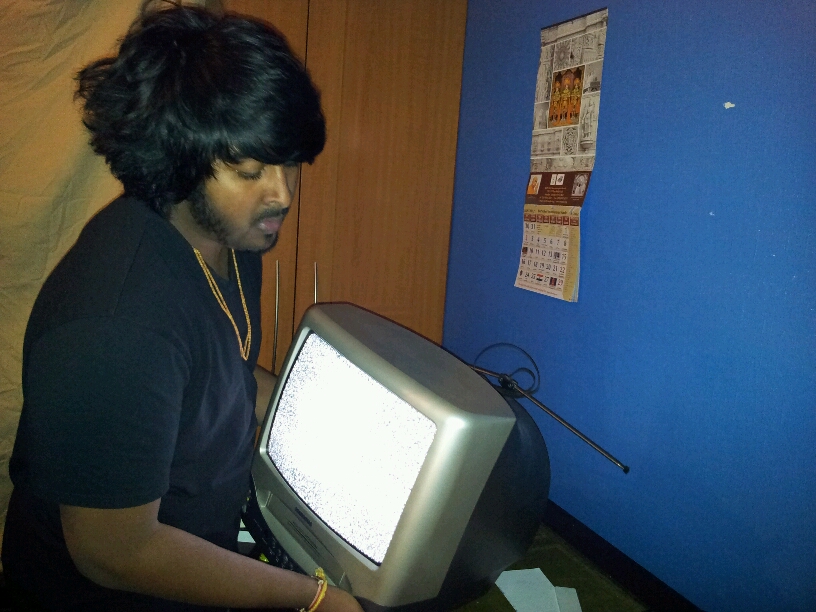
I am really pleased with the location ( rahuls room) becuase it is almost exactly what we wated it to look like. Alot of weight was lifted of our chests as rahul had already owned and old fashioned television and radio with an aerial. We would have had to go to alot of hastle to get our hands on these objects. These objects were key in our opening sequence. Moreover, the room was nice and compact which made lighting easier as our source of light protruded throughout the whole room whereas it would not in a bigger room.
Tuesday, 7 February 2012
Extreme close ups


These 3 extreme close ups are again from the host trailer. This is how we opened our sequence by using extreme close ups of objects and also abstract objects. This was our only inspiration for our first opening shots and we are glad that we found this trailer as it has given us numerous ideas about our opening sequence. These shots require prescision and technique and we spent alot of time trying to perfect our version of these shots and trying to get them to resemble these and apply the same effect.
Soundtrack
This is a teaser trailer of a film called host by Danny Lacey. The soundtrack of this piece is exactly what we are trying to re create because it is simple yet very effective. The soundtrack is mostly just one sound played on a loop, this sound is eerie and gloomy, it builds tension and when a typical audience hear this soundtrack, they would instantly think something bad is happening or that this is from a horror/thriller movie. We will try and re create this using garageband.
Fonts


These above are to font ideas that really grab our attension and apeal to us. As we are shooting a crime thriller, we need fonts that depict violence/ horror elements. We found this website called dafont and searched this site for relevant fonts. We narrowed our search to these above. They brilliantly illustrate the visual effect we are after and also they are iconic and typical fonts that would be emplyed in a horror/thriller film.
Wednesday, 4 January 2012
Our credit ideas so far
Distributor - Paramount, regency
Company Logo
Crossfire Productions Presents
A Snehal Khimani Film
Rahul Horeesorun
Samir Sarwari
Mind Games
Zack Grenier
Eion Bailey
Matt Mcallney
Casting by - Micheal Dunham
Costume designer - Richard Molloy
Music by - Stephen Cox
Film editor - Janet Fincher
Production designer - Alex O'neil
Director of photography - Philip Bloom
Executive Producer - Andrew Hall
Directed by - Snehal Khimani
Company Logo
Crossfire Productions Presents
A Snehal Khimani Film
Rahul Horeesorun
Samir Sarwari
Mind Games
Zack Grenier
Eion Bailey
Matt Mcallney
Casting by - Micheal Dunham
Costume designer - Richard Molloy
Music by - Stephen Cox
Film editor - Janet Fincher
Production designer - Alex O'neil
Director of photography - Philip Bloom
Executive Producer - Andrew Hall
Directed by - Snehal Khimani
Inspirational Music
HORROR MUSIK by Park High Media
This is a track which i found on youtube which really grabs my attension. We are going to shoot scene of a serial killer which requires non diegetic sound to reflect his personality. The first 20 seconds of this video is what im interested in as it builds up in texture and volume. This section of the clip indicates suspense and tension. The effect i really like is the trumpet sound between 15-20 seconds. This very sound is used in lots of thriller/horror films and i would definetely want to employ this into our opening sequence.
Snehalsoundtrack ideas by Park High Media
This is another clip that i have found on youtube that grabs my attension. What i like about this track is that its dramatic and has certain jumps and cuts. These cuts are essential as they can show the characters actions and what he is doing. Within this clip from about 7-10 seconds, is exactly what im looking for, it builds up quickly and then takes a sudden drop and then carries on again. I would use this in our sequence to show a significant action/image.
This is a track which i found on youtube which really grabs my attension. We are going to shoot scene of a serial killer which requires non diegetic sound to reflect his personality. The first 20 seconds of this video is what im interested in as it builds up in texture and volume. This section of the clip indicates suspense and tension. The effect i really like is the trumpet sound between 15-20 seconds. This very sound is used in lots of thriller/horror films and i would definetely want to employ this into our opening sequence.
Snehalsoundtrack ideas by Park High Media
This is another clip that i have found on youtube that grabs my attension. What i like about this track is that its dramatic and has certain jumps and cuts. These cuts are essential as they can show the characters actions and what he is doing. Within this clip from about 7-10 seconds, is exactly what im looking for, it builds up quickly and then takes a sudden drop and then carries on again. I would use this in our sequence to show a significant action/image.
Thursday, 15 December 2011
Target Audience Research - Audience profiles
When producing and marketing a film, it is really important to research your target
audience. This audience can be responsible for feedback in terms of what the like or dislike about the chosen genre. This enables you to make something made fit to the target audience taking into account the feedback. By observing the chart below which i got from the pearl and dean website, we can see that 39% of the cinema audiences are aged between 15-24, which is within the range of our target audience. Secondly, in the gender collumn, we can see that males and females are almost the same in both the population and cinema audience, this shows that our target audience of males in terms of gender do go to the cinema and make an appropriate target audience.
 From this table of ratings for se7en from the IMDB website. We can clearly see that there is a heavier concentration of male ratings in comparison to females. This also fits in with our target audience as between the ages as of 18 and 29, the males dominated the females in terms of ratings.


BBFC Ratings
After viewing the BBFC website, we have come to a conclusion to rate our thriller as a 15. This means that nobody under he age of 15 can rent or buy media products given a rating of 15.We decided this because it contain scenes of strong violence and unacceptable behaviour which we feel may influence the younger generation. Secondly, our film contains strong language such as swearing. Additionally, within the film there are drugs and the use of a kitchen knife as a weapon for murder. We feel that young children may be very frightened of this and also may possibly try to imitate the behaviour i.e using a knife as a weapon or replicate the swearing used in this film. On the other hand, the audience ages 15 and over are more mature and know not to be influenced by the violence or the strong language portrayed in the film.


Wednesday, 14 December 2011
Tuesday, 13 December 2011
Narrative Research
The narrative of a film is generalised these days by simply saying it has a begining, a middle and an end. Howver, there are more stages of films have been stated in more detail. The basis stages are:
Todorov's theory of narrative is made up of five stages, this conists of the following:
Roland Barth sayd that all narratives share structural features that are brought together in different ways. Even though there are differenenes between individual narratives, they all have a limited number of organisational structures that affect our reading of the text. These are called narrative codes.
On the other hand, Vladimir Propp also concluded that all the characters could be resolved into 8 character types:
- Exposition - This gives us the simple introduction to the story
- Disruption - Here there is an obstacle, in the story
- Climax - At this point there is a turning point
- Resolution - Everything is restord and there is balance once again.
Todorov's theory of narrative is made up of five stages, this conists of the following:
- The equilibrium is the point where characters are introduced (major and minor) and the story commences.
- Disruption- The antagonist(s) would be introducedand the story starts to divert slightly.
- Recognition- The disruption has been recognised. The effects of the disruption start to take place mainly on characters.
- Attempt to repair- At this stage, the disruption is repaired and resolved.This i would say is the peak of the film.
- New equilibrium- Here, the diruption is gone and effects of it have eased away. There story usually ends on a high note.
Roland Barth sayd that all narratives share structural features that are brought together in different ways. Even though there are differenenes between individual narratives, they all have a limited number of organisational structures that affect our reading of the text. These are called narrative codes.
- Enigma Code - A narrative device that teases the audience with a puzzle or riddel
- Action Code - Events we know that will be significant in the development of the narrative.
On the other hand, Vladimir Propp also concluded that all the characters could be resolved into 8 character types:
- The villain - Who struggles against the hero.
- The dispatcher - The character who makes the weakness known and sends the hero off.
- The (magical) helper - helps the hero in the quest.
- The princess or prize - the hero deserves her throughout the story but cant to marry her because of an unfair evil, usually because of the villain. The hero's journey is mostly ended when he marries the princess,also beating the villain.
- Her father - gives the task to the hero, shows the false hero, marries the hero.
- The donor - prepares the hero or gives the hero some magical object to help him.
- The hero or victim/seeker hero - reacts to the donor, weds the princess.
- False hero — takes credit for the hero’s actions or tries to marry the princess.
- Good vs Evil
- Boy vs Girl
- Humanity vs Technology
Todorov's Equilibrium and Disequilibrium Model

Above, i have written down the different stages of the Todorov narrative structure for two films, Star wars and Se7en.
Narrative Notes


This image on the left shows the notes we wrote on narrative in the lesson. It consists of a basic narrative format, todorov's narrative format. Secondly, i have wrote out the different stages of the narrative for little red riding hood using todorov's method. Moreover, i mention Roland Barthes and his enigma and action codes. To conclude, i stated different ways in which the narrative can be manipulated.
Subscribe to:
Posts (Atom)